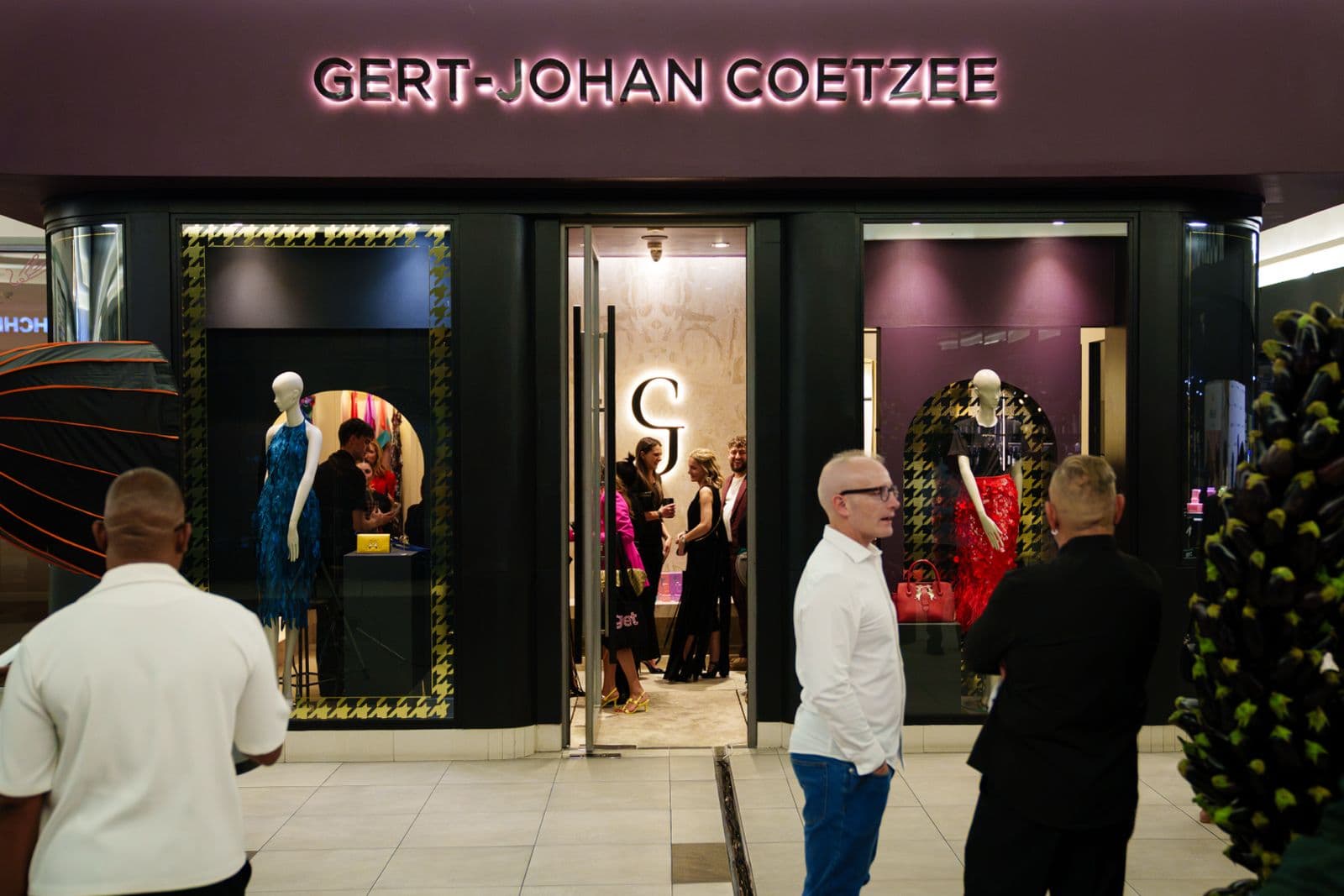
Gert-Johan Coetzee knows a lot about materials. The internationally celebrated South African fashion designer has spent most of his career thinking about them. How they move. How they fall. How they catch the light. How a change in texture, proportion or structure can completely change the way something feels.
Usually, he is thinking about clothes. Designing his first physical boutique at the Winifred Mandela Precinct in Johannesburg meant thinking about materials that behave differently. Stone doesn’t move. But, as Coetzee discovered, it can do almost everything else.
“For me, it was a shift from the body to the environment,” he says. “In fashion, material responds to movement, proportion and the human form. In a space, material has to create that same emotional response through scale, surface, light and permanence.”
It changes the way you think about surfaces. Because whether you are designing a house, a hotel, a restaurant or a fashion boutique, it’s very easy to start with a fairly predictable question. What stone do I like? Coetzee started somewhere else. What does the space need the material to do? That small shift changes everything. Veining can create movement across a large surface. Texture changes the way light behaves. Scale can make a material feel quiet or dramatic. Reflection can bring energy into a space, while continuity can make separate elements feel as though they belong to one architectural thought.
Coetzee calls marble and porcelain “architectural textiles”. Coming from a fashion designer, it’s a particularly good description. A designer would never choose a fabric simply because it looked beautiful folded on a table. They would want to know what happens when it is cut. How it falls. Whether it holds its shape. What it does when someone moves. Coetzee approached the surfaces in his boutique in much the same way. “I wanted a dialogue between the two,” he says. “The fashion remains the focal point but the surfaces establish the world around it.” And that meant knowing when the material should speak. And when it should simply hold the space. The clothes are the things that will constantly change. New collections will arrive. Colours and silhouettes will come and go. Displays will move. The stone has to live with all of them.
“Fashion is transient by nature while stone suggests endurance and memory,” says Coetzee. “One changes with the body and with time, while the other anchors a space.” That idea of an anchor matters. A permanent surface doesn’t have to be the loudest thing in a room to have enormous influence over it. It can create proportion. Establish rhythm. Give a space weight. Connect one area to another. Or simply provide enough calm for everything else to be noticed.
What's your hot take on this story?
In the boutique, Infinity Surfaces Taj Mahal flooring and Perlato Olympo marble surfaces were used as part of the composition of the interior. Then something happened that every good designer will recognise. The materials started changing the design. Coetzee says this happens in fashion too. You begin with an idea, discover a fabric you hadn’t expected and suddenly the silhouette changes. The original idea isn’t lost. It evolves because of what the material made possible. “A strong concept gives you direction but materiality often reveals possibilities that you could not have imagined at the beginning,” he says. “As we explored the Interslab materials, new possibilities for the space emerged.”
For Chad Raats, Marketing Manager at Interslab, working with Coetzee pushed the material conversation further. “Gert was interested in what the surfaces could bring to the space. How they could connect mood, add weight, work with the clothes and become part of the architecture. That gave us a very different starting point,” says Raats, “We were designing with stone.”
The boutique marks the beginning of Interslab’s Crafting Extraordinary collaboration with Coetzee. The idea behind it is simple. Bring great creative minds together with extraordinary materials and see where the two can go. Coetzee wanted people to understand something about his brand before they had touched a garment. Precision. Confidence. Craftsmanship. “Luxury, for me, is not simply about opulence,” he says. “It is about the quality of every decision.”
Which brings us back to material. We choose it for colour. For texture. For the way it catches the light. Yet its real power may be something harder to see. The way it changes how a space feels. And, ultimately, what that space becomes.